Evans, Boults & the War Years (1936-1946)
Barbara and her husband Stuart (a solicitor on Broad Street), lived at the house until 1946 with a break during some of the war years (1939-41).
A central heating plan from 1937 shows that some of the upstairs rooms were still being used as maid’s bedrooms and bathroom and a separate flight of stairs connected these rooms with the living areas below. What is now the kitchen and previously the “morning room” was used as a nursery.
This period saw the arrival of best-known occupant of the house to date. Sir Adrian Boult CH (1889-1983) was one of the most influential people in British classical music during the last century. Amongst his many achievements, he is known for having been the founder of the BBC Symphony Orchestra and the first person to conduct a live performance of Gustav Holst’s The Planets.
He conducted the orchestra at the 1937 [King George VI] and 1952 [Queen Elizabeth II] coronations in Westminster Abbey. In this capacity, he was the first to perform both Walton’s Orb and Sceptre, and his Crown Imperial as well as Bliss’s Processional. He is also known for having introduced further works by Elgar, Britten, Stravinsky and his good friend Vaughan Williams – who is also connected to Bristol, having completed The Lark Ascending at Kingsweston House some time earlier.
.jpg)
It was the BBC orchestra which brought him and his wife Ann (Wilson, nee Bowles) to the house, as the group was moved to Bristol during the first part of WWII to ensure “continuity of service”. He never owned the house but lived in it for a short while (1939-41) as Stuart Evans served in the Army during the war and the family moved temporarily to Weybridge, and later to Bath. His stint as the BBC’s Director of Music (1930-1942) overlapped with his time in the property, as did his period as the chief conductor for the BBC Symphony Orchestra.
“My wife and I were lucky to find a furnished house, and the owners were kind enough to turn out immediately,” Boult wrote in his 1973 autobiography, My Own Trumpet.
Boult would have crossed the Clifton Suspension Bridge on most working days as his offices were on Pembroke Road in Clifton. According to his principal biographer, Michael Kennedy, Boult have away his own protective hats used for air raids to the staff at the bridge, to the alarm and puzzlement of his own staff. Boult also served as a lieutenant in the Home Guard during his stay at the house, resigning his post when the orchestra was later moved. We know that the pianist Dame Myra Hess DBE stayed a night in the longest of the three bedrooms overlooking the front garden.

Sir Adrian, the orchestra and Bristol suffered a great deal during the first year of the war. He was conducting at Colston Hall when he found out his own flat in London had been destroyed during a raid, erasing his own personal recordings and causing him to remark: “I shall have to conduct from memory in the future”.
Most tragically, a BBC orchestra bass player and his wife died during a raid in Bristol. On another occasion, the windows of their Pembroke Road office were blown out in the same raid which destroyed much of All Saints Church. The orchestra’s entire set of instruments were saved when their driver loaded them into a van and parked them in the middle of the Downs.
We can only assume that Sir Adrian and Ann would have used the cellar as an air raid shelter during the night-time attacks on Bristol. Leigh Woods was used as a ‘QL’ decoy for Filton’s aircraft factory – the largest in Europe at the start of the war. One company of the 7th Home Guard Battalion was stationed on the edge of the woods, though not near this property.
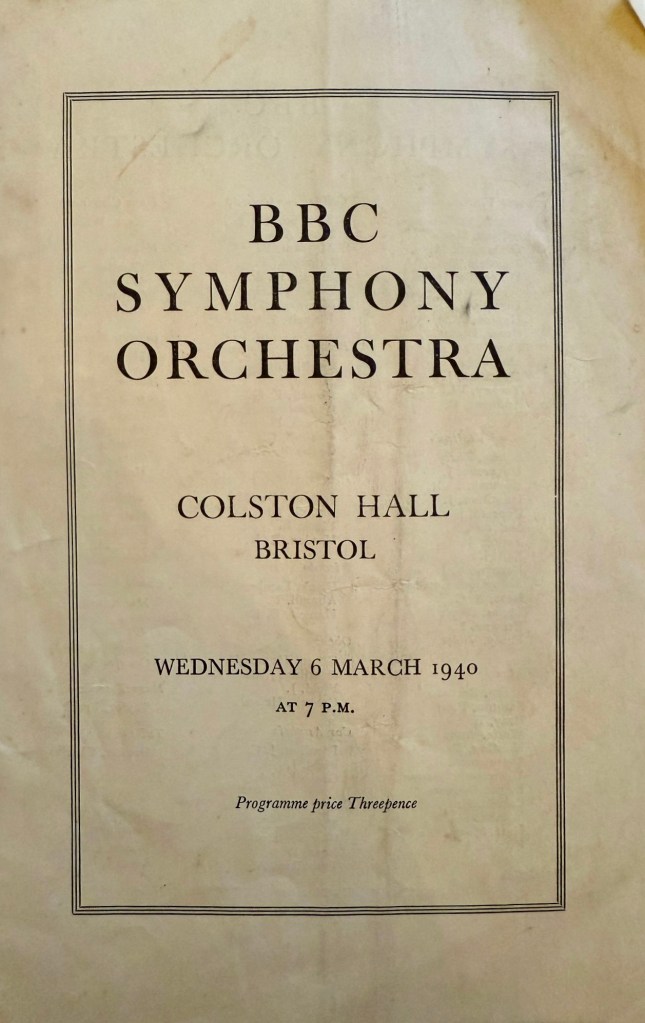
Details of a few Adrian Boult (and the BBC Symphony Orchestra) performances at the Colston Hall, Bristol, courtesy of the University of Bristol Archives, who hold the historic programmes for these performances.
* BBC Symphony Orchestra: 1st November 1939. Solo pianoforte Myra Hess. Conductor Sir Adrian Boult [it is assumed this is when Dame Myra Hess stayed at the house]
* BBC Symphony Orchestra: 22nd November 1939. Solo Violin Albert Sammons. Conductor Sir Adrian Boult
* BBC Symphony Orchestra: 6th December 1939. Conductor Sir Adrian Boult
* BBC Symphony Orchestra: 31st January 1940. Soloist Eva Turner. Conductor Sir Adrian Boult.
* BBC Symphony Orchestra: 21st February 1940. Conductors William Walton and Sir Adrian Boult
* BBC Symphony Orchestra: 6th March 1940. Solo pianoforte Lamond. Conductor Sir Adrian Boult
* BBC Symphony Orchestra Summer Concerts 1940. 5th June. Solo Piano Forte Solomon. Conductor Sir Adrian Boult
* BBC Symphony Orchestra Summer Concerts 1941. 18th June. Solo pianoforte Moiseiwitsch. Conductors Clarence Raybould and Sir Adrian Boult
* BBC Symphony Orchestra Summer Concerts 1941. 25th June. Soloists included Isobel Baillee. Conductor Sir Adrian Boult
One object the house has retained is a letter to “Lady Boult”, found behind the fireplace in the former breakfast room (now study), during a major renovation in the early 2000s. It appears to be a letter from her son, Jonathan Wilson asking her view on remaining in the Officer Training Corp. Jonathan Wilson was to join the Scots Guards, 3rd Battalion in January 1944, and died in active service on 20th November of that year. The Boults did not have children of their own, Jonathan was from Ann Boult’s first marriage.
More information on Jonathan’s life can be found here.
Letter from Jonathan Wilson (3rd Scots Guards, 1924-1944) to Ann Boult. Found behind the fireplace in the “Breakfast Room”, now Study in 2003.
Littlefield*
(27/XI/40?)
Dear Gardner [?]**
Thank you for your p.cs. I gather it has been rather hot! We have had 2 alarms yesterday which came in the middle of our upper match & so we have to replay, which is rather annoying as we are winning (for once!).
I did go to O.M.H in Sept. 1932 & football photos are taken in that term. I have been thinking of leaving the O.T.C. It seems to be a waste of time. I have reaped a good deal from it and don’t think I can get anymore. And if I do have to join up, I shall go into the Navy. It bores me stiff and I loath the army’s mechanical way of thinking. Whatsayyou?
Much love from,
Jonathan
[..you tell me quite soon, how I am to come back on the 17th?]
*Littlefield is now, as it was then, a boarding house at Marlborough College, where Jonathan was a student. According to David Lister, Marlborough’s South Aisle Chapel chancel was consecrated in 1946 in memory of Jonathan Wilson by the Lord Bishop of Sodor and Man.
**A nickname?


The extent of the Bristol Blitz resulted in the orchestra being moved to Bedford in early 1941, where it would remain for the rest of the war. Boult’s biographer, Michael Kennedy, says he protested this move but was overruled. It is worth noting that Boult had left the city by the time the Clifton Rocks Railway had adopted its role as a bomb-proof relay station and emergency studio. As such, Boult notes “it was decided we should record our concerts in the afternoon and then disperse to our homes, leaving the brave engineers to play it.”
“We were very sad to leave Bristol,” Boult wrote in his autobiography, “We had all made many good friends; it was in every way a delightful city, and we had splendid audiences there. It was deplorable that the fine Colston Hall should have been burnt down one night from unknown causes when it had escaped the raids.”
Boult would of course return to Bristol during the war and thereafter. On 25 June 1941, he conducted the Bristol Choral Society in Mendelssohn’s Hymn of Praise at Colston Hall.
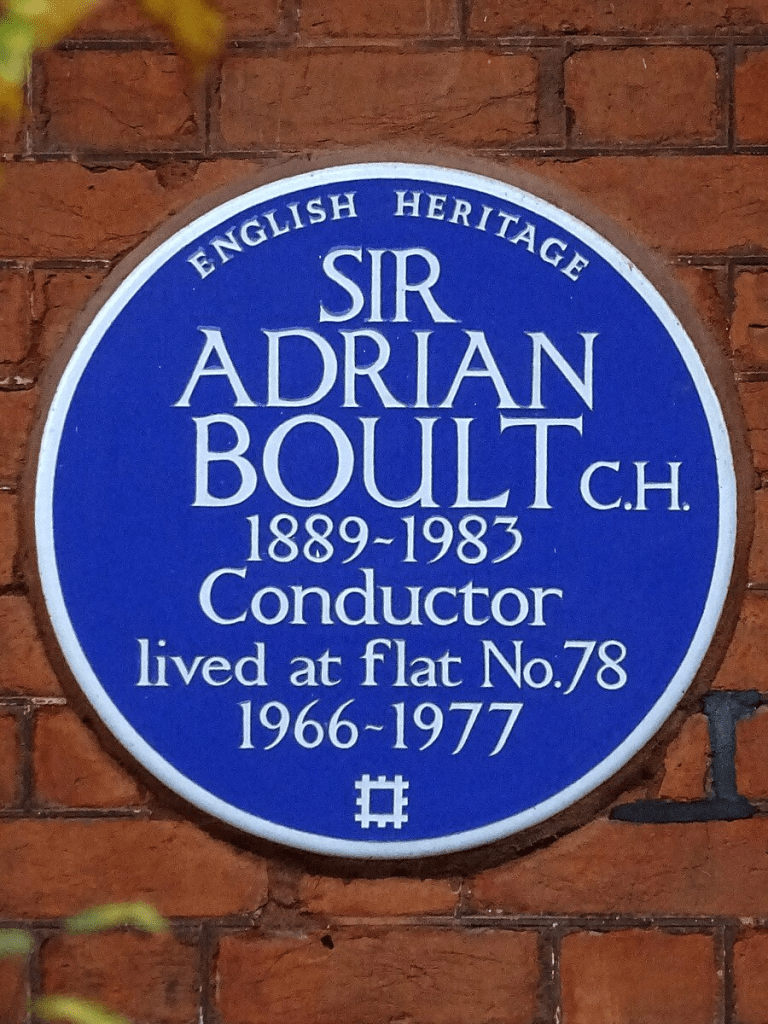
The house does not have a marker of this time here, save for a patch of rust on the hallway’s Victorian floor tiles, apparently the result of an unresolved leak while the house was in the care of the BBC. His flat in West Hampstead has a blue plaque and he has a memorial stone at Westminster Abbey. There is also an “Adrian Boult House” in Mansford Park (Bethnal Green, London).
The Lucas period (1946-1953)
The Lucas family acquired the property from the Evans’s in August 1946. Hastings (later Herbert) Pollard Lucas had taken on responsibility for the family firm, T P Lucas, a major supplier of cooking ingredients which is still in business as Lucas Ingredients in Bristol today. The company website tell us:
“The company was founded by Thomas Edward Lucas in Bristol in 1926 and was the first to manufacture yeastless rusk – a purpose designed cereal binder for butchers who had previously used returned stale bread for their sausages.
From there, the company achieved other “firsts” such as offering “own recipe” and standard blended seasonings to the trade in the 1930s, going on to introduce the first fully blended cure mix, making curing more practical for everyone. Lucas was also the first to introduce coloured seasonings, coloured crumb for hams and the first to manufacture textured soy proteins.”
H P Lucas is said to have been particularly pleased that the house came with a cellar and remained at there until 1953 when the family moved to Wraxall Court. In common with other Lucas’s, H P was a member of the Clifton Club and the first winner of the annual 100 Club draw. Curiously, H P Lucas’s daughter, Elizabeth S Lucas, appears to have left her blue trunk in the attic, it remains in the house to this day.
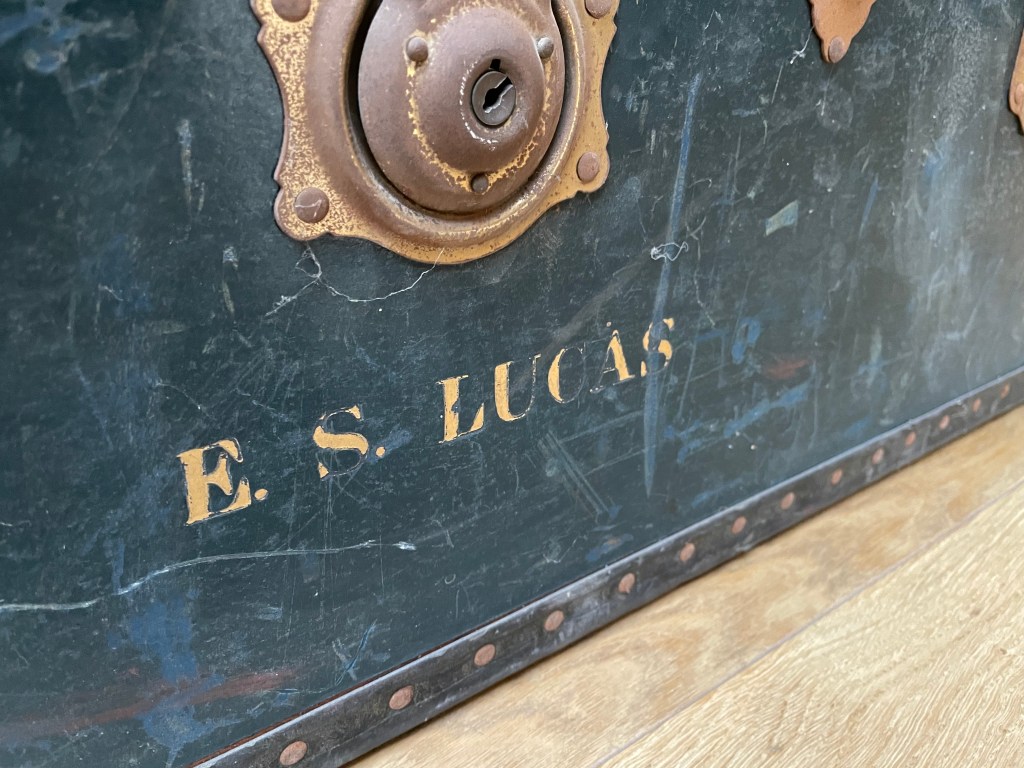
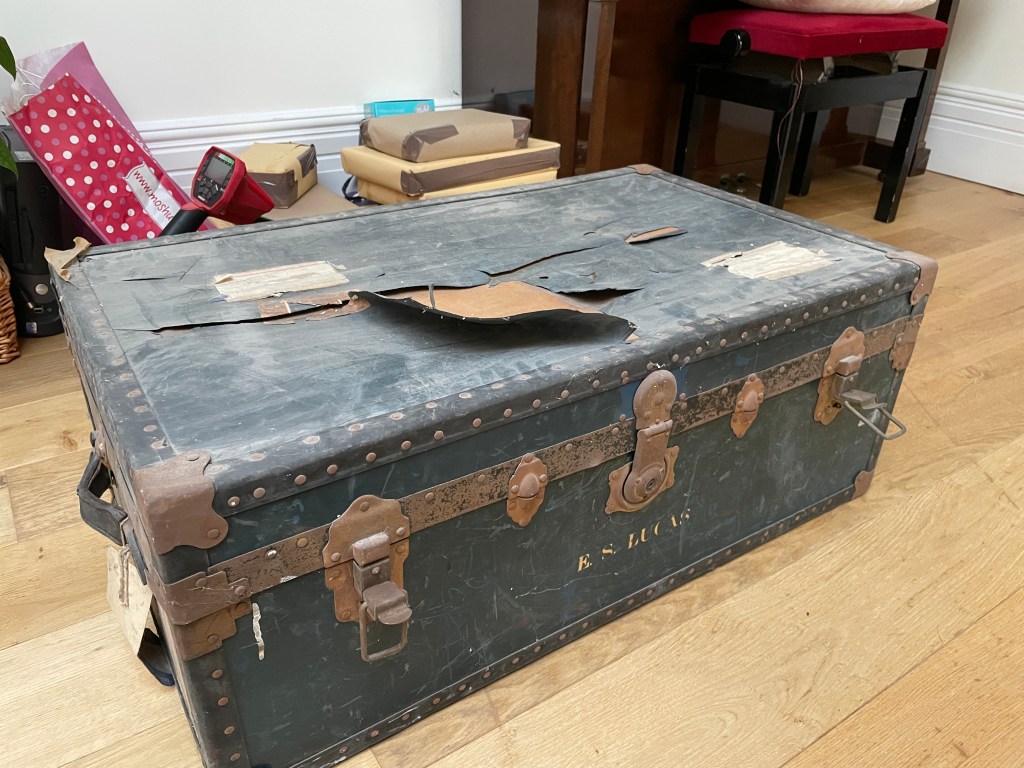
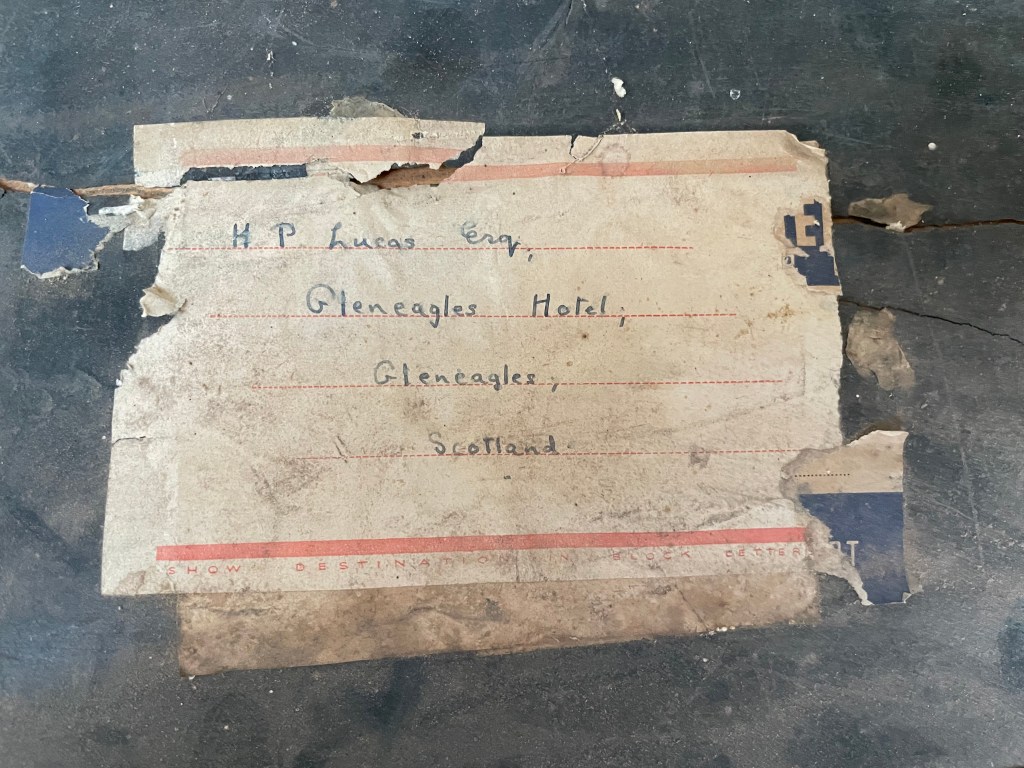

E S Lucas’s trunk. Left behind in the house. Image: Ashley Coates Attribution-NonCommercial-ShareAlike 2.0 Generic (CC BY-NC-SA 2.0)
 A History of a Bristol House